Faster movement learning, measured on every attempt.
GOAT is an elegant solution to a hard problem: teaching the nervous system a movement and proving, attempt by attempt, that it's taking hold. Each part of the experience is there for a specific reason and is grounded in motor-learning science, neuroscience, and the psychology of learning.
Three steps.
Prime
A deep-focus VR experience in which the nervous system performs perfect practice of the movement through the mirror neuron system, before the body moves at all. No effort, no errors rehearsed.
Embody
Proprioceptive excitement that moves the pattern from passive to active, so the body begins to own the movement it has just experienced.
Practice
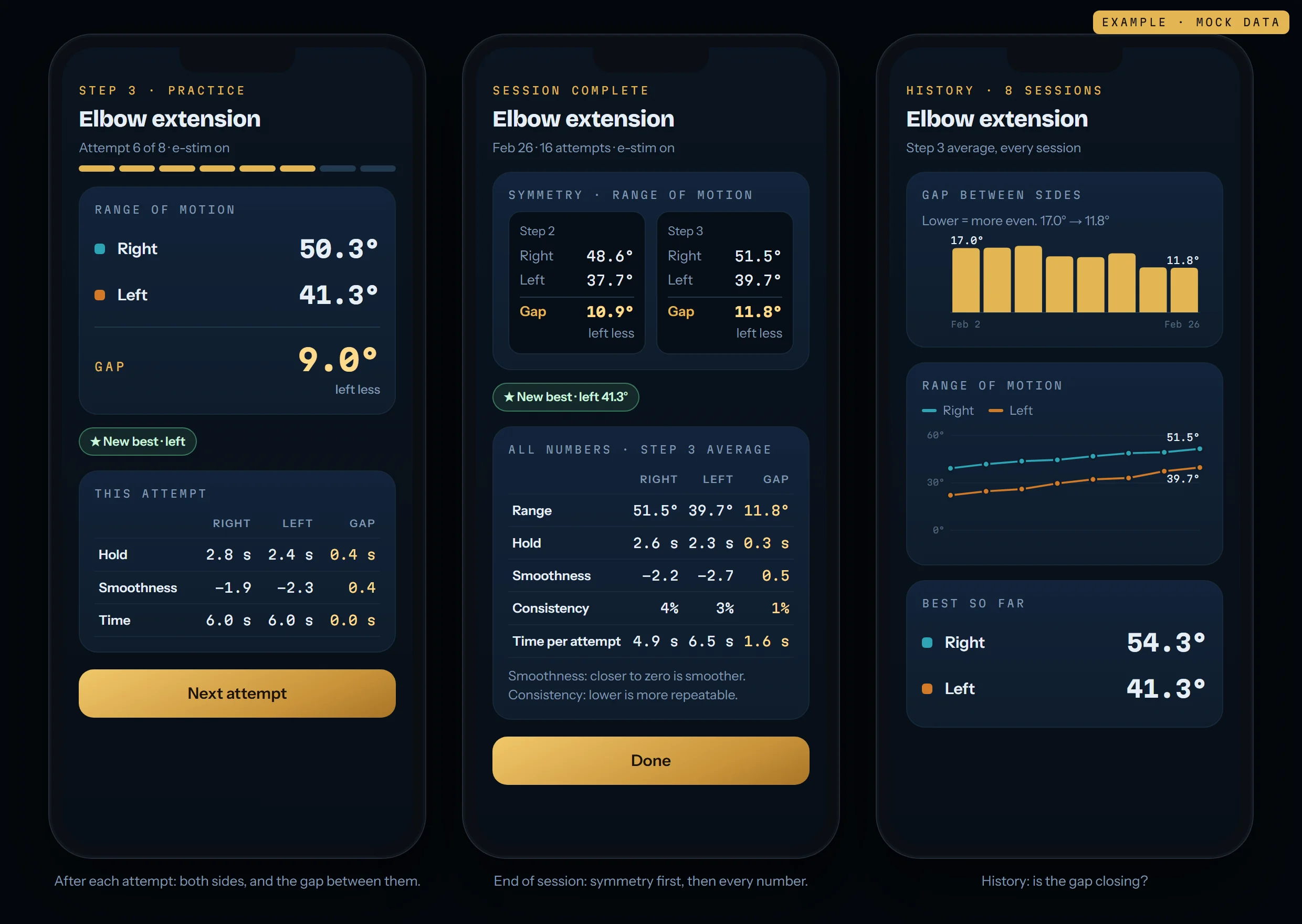
The movement itself, with real-time sensor feedback on every attempt.
Full session. All three steps, with sensors on both sides of the body. 30–45 minutes with electrical stimulation.
Short session: Step 1 on its own. Extra repetitions of the perfect movement on the nervous system, with no physical effort. Often used just before and after sleep, when the brain consolidates what it has learned. Fits easily between therapy sessions.
What we stack.
Each layer is chosen to open a specific door to learning. Together they form one loop.
Mirror neurons: effortless patterning
The same motor circuits fire when we watch a movement as when we perform it. Structured, repeated observation patterns the desired movement onto the body before physical practice begins, so the first physical attempts follow a correct template.
Rizzolatti et al., 1996Audio stimulation: a relaxed, focused brain
Audio built to settle the nervous system and hold attention, so the brain takes in the movement in a state that favours learning.
Systematic reviews of binaural beat audio: attention and anxietySensory reweighting: proprioceptive enhancement
Vision claims a large share of the brain's processing. When visual input is quieted, the brain reallocates that capacity to the body's own signals, and position sense and balance sharpen. Paired with slowed movement, every part of the motion is felt in full, giving the primed pattern room to cross from observation into action.
Peterka, 2002Electrical stimulationOptional
With the medical team's approval. A signal from the muscles the patient is working to reach gives the brain a clear target to recognise and connect with as the movement is practised.
A completed learning loop
The brain learns by linking an action to its result, and that link fades within seconds. Sensor feedback arrives inside that short window, with the same objective measure every time, so the brain knows exactly what the body just did. Most practice never closes this loop with objective results in real time.
Schmidt & Lee, Motor Control and LearningOne focus at a time
Working memory is small. Each exercise has one focus number, so the brain isn't flooded and can commit to the change that matters most.
Sweller, 1988The right level of challenge
Learning chemistry depends on high focus and low frustration. The protocol keeps each patient working at the edge of what they can do, where progress is visible and motivation holds.
Guadagnoli & Lee, 2004Sleep consolidation
Motor memories strengthen during sleep. Short sessions placed around sleep give the brain a fresh pattern to consolidate.
Walker et al., 2002Each layer is a proven driver of motor learning. Sequenced together, each one amplifies the next.
The result is deliberate practice (a clear model, immediate objective feedback, targeted repetition and full attention on every attempt) built as a system, rather than left for each learner to discover. Ericsson et al., 1993
Every attempt. Both sides.
- Range of motion (degrees)
- Hold time (seconds)
- Smoothness (a published smoothness measure)
- Consistency: how repeatable the attempts are
- Time per attempt
- The gap between right and left on each of these, so asymmetry is tracked over time
- Movement in space for whole-limb exercises, and whether a small movement registered at all
- Best and average for each step, and new bests over time
- Every attempt counted and logged against the schedule, including session conditions such as stimulation on or off
Every repetition counts, including the passive ones.
Each repetition viewed in the mirror neuron step is logged as one perfect practice on the nervous system, toward a set target for each movement.
Personal refinement, as the data grows.
Once enough attempts are recorded for a patient, the data shows where small refinements to their exercises, timing or emphasis will help most. On the roadmap.
The data doesn't stay on a phone.
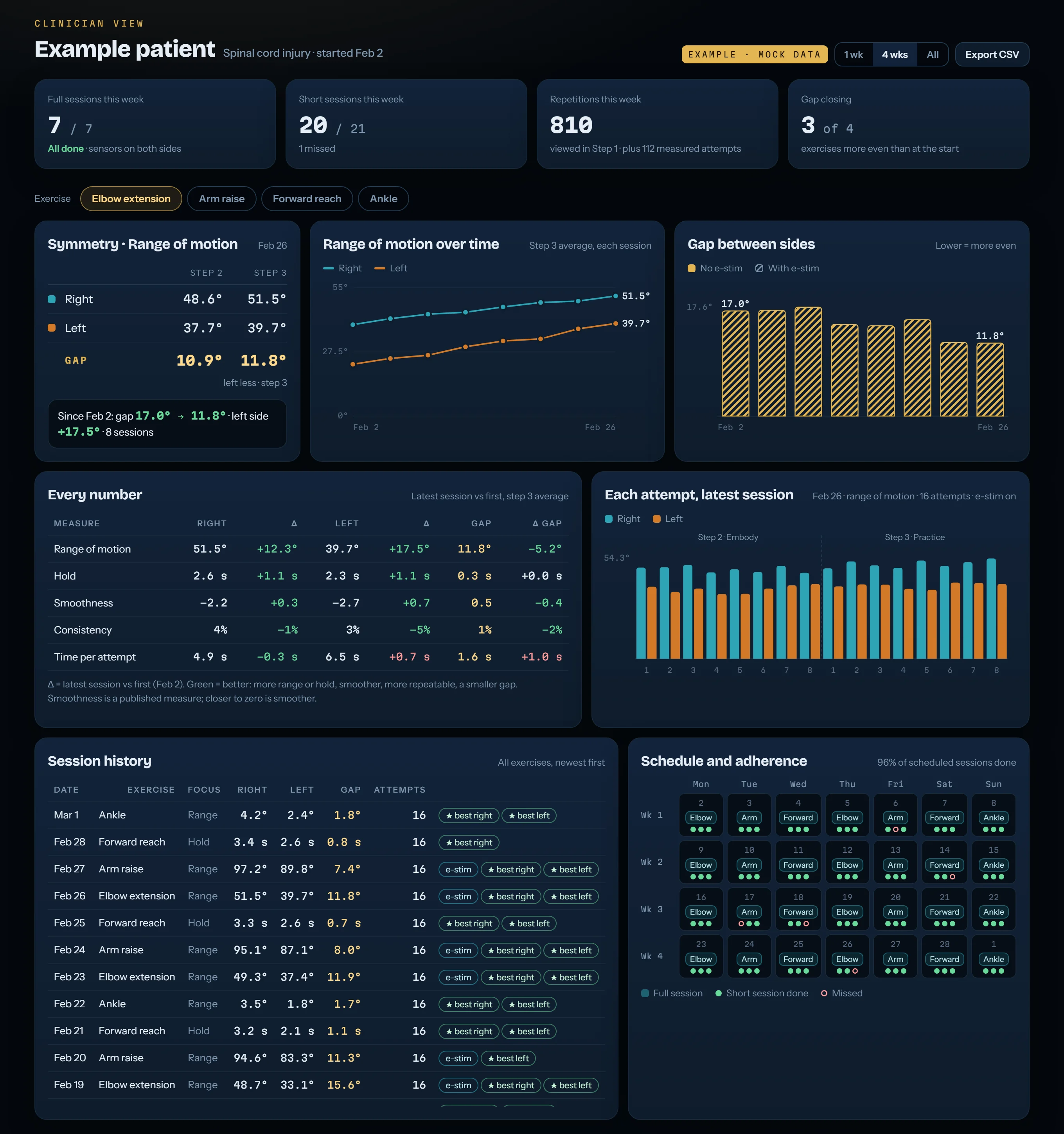
Every session goes to a dashboard the family and their clinicians can read: what was done, on which day, how each side moved, and the full history of past results, session after session.
Smartphone app: real-time view
Web dashboard: for families and clinicians
Simple to run.
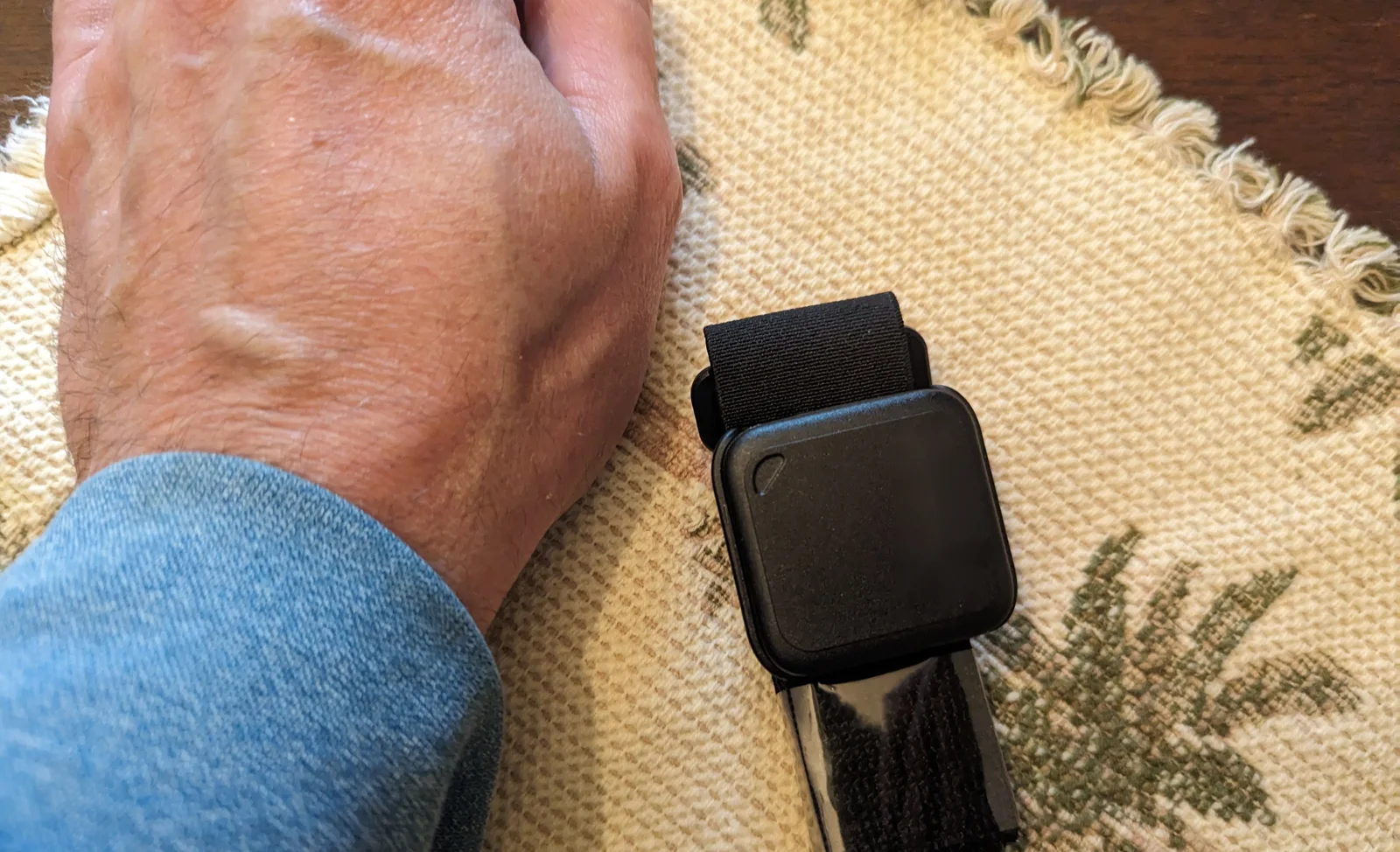
- Small wearable sensors, held on with straps or a vest, and automatically pair in the app.
- No cameras needed.
- A VR headset and earbuds for Step 1. Specialized goggles are worn for Step 2.
- The app runs the session step by step and tells the user where each sensor goes for that exercise.
- We train the people who run the sessions, whether family or staff, in person or by video call.
Measure only.
The sensors are light and passive: they only measure. Sessions are short and can be done seated or in bed. Electrical stimulation is optional, and only with devices and settings approved by the patient's medical team.
Studied, published, in use.
A high school swim team split into a test group and a control group. The group using the method improved at 2.3× the rate of the control group (p = 0.048). That study tested the learning method alone, without real-time sensor feedback.
Read the original results (PDF; the method was then called IKKOS) →Adults with developmental and intellectual disabilities, in an 8-week adapted tennis program (one hour, twice a week). All participants showed significant improvements in forehand and backhand technique.
Read the published study →Youth with autism, ages 8–18, across the full spectrum, learned tennis skills with video modelling and sensor feedback as part of the program's supports, over 8 clinics in 4 weeks.
Read the paper (PDF) →Students with cerebral palsy, autism and traumatic brain injury. Walking posture improved from about 60° to 80° (90° = upright) in 3 weeks at about 2 hours a week. Stair climbing: +40% on a physical therapist's rubric and 30% faster in 2 weeks. Daily-living skills: +67% average on an independence rubric over 8 weeks.
Read the case study →The data belongs to the patient.
Patient data belongs to the patient and their family. Session data is stored under an account ID, not a name. It is never shown publicly, never sold, and never used in anyone else's materials.
See it with your team.
We're glad to walk your team through it, with the sensors and the data in hand.
goat@goatloop.com